
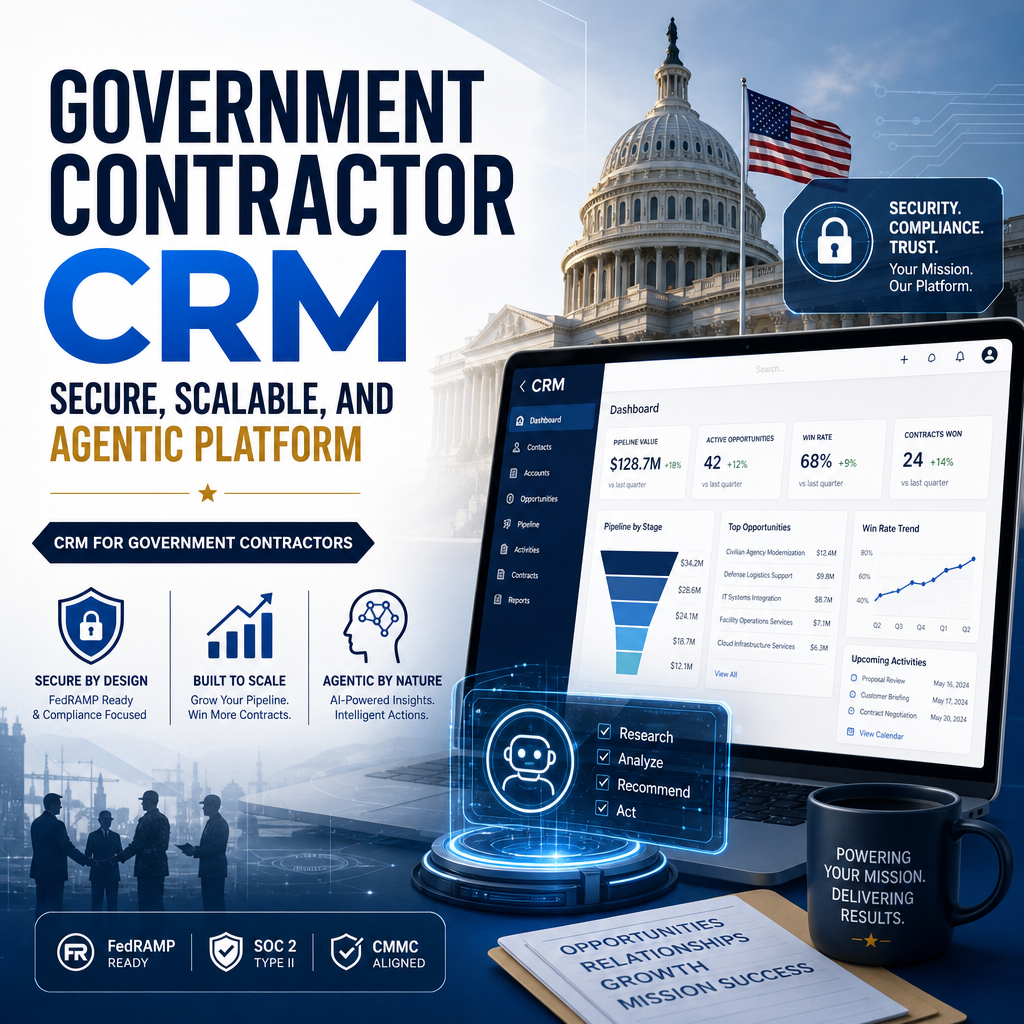
Government Contractor CRM: Secure, Scalable, and Agentic Platform
The CRM Built for Government Contractors: Secure, Scalable & Agentic
Government contractors operate in a world where every lead, proposal, and contact can carry compliance risk, security requirements, and long sales cycles. A generic CRM may help a commercial team manage deals, but it often falls short when the pipeline includes capture strategies, set-asides, contract vehicles, and sensitive government data.
That is why the modern CRM built for government contractors needs more than basic contact management. It has to be secure enough for regulated work, scalable enough to support growth across multiple programs, and agentic enough to automate the busywork that slows teams down.
Why Government Contractors Need a Different Kind of CRM
Selling into the public sector is not the same as selling into commercial markets. The buyer journey is longer, more structured, and often influenced by procurement rules, certifications, and past performance.
A government contractor CRM must support:
- Long sales cycles with multiple stakeholders
- Opportunity tracking tied to agencies, contracts, and task orders
- Compliance-sensitive data handling
- Collaboration between business development, capture, proposals, and delivery teams
- Clear visibility into pipeline health and bid readiness
Without those capabilities, teams end up stitching together spreadsheets, email threads, and disconnected tools. That creates blind spots and makes it harder to respond quickly when an opportunity opens.
Security Is Non-Negotiable
Security is one of the biggest reasons government contractors need specialized CRM software. These organizations often manage sensitive contact details, internal pursuit strategies, and confidential opportunity data.
A secure CRM should include:
Essential security capabilities
- Role-based access controls
- Data encryption at rest and in transit
- Audit logs for user activity
- Multi-factor authentication
- Permission settings for teams, regions, or programs
- Secure cloud architecture with strong compliance practices
For government contractors, security is not just about protecting data from external threats. It is also about limiting access internally so the right people see the right information. Capture managers may need full visibility into a pursuit, while finance or operations teams may only need a subset of records.
A secure CRM built for government contractors helps reduce risk while keeping collaboration smooth.
Scalability Matters as Pipelines Grow
Many contractors start with a small business development team and a few opportunities. Over time, the organization expands across agencies, contract types, and partners. A CRM that worked at the beginning can quickly become a bottleneck.
Scalable CRM systems help teams:
- Add users without losing performance
- Manage larger contact and account databases
- Organize opportunities by agency, program, or contract vehicle
- Standardize workflows across business units
- Track growth metrics without manual reporting
Scalability is especially important for firms that move from a handful of pursuits to dozens of active bids. The CRM should grow with the business, not force the team into a costly migration every time the pipeline becomes more complex.
What Makes a CRM Agentic?
“Agentic” CRM refers to a system that does more than store information. It can actively assist users by automating tasks, surfacing insights, and helping teams make decisions faster.
In practical terms, an agentic CRM can:
- Suggest next steps based on pipeline activity
- Auto-create follow-up tasks after meetings or emails
- Summarize pursuit history for capture teams
- Flag stale opportunities or missing fields
- Recommend similar accounts or past performance references
For government contractors, this kind of automation is valuable because it cuts down on administrative work. Teams spend less time updating records and more time developing strategy, building relationships, and writing winning proposals.
Examples of agentic workflows
- A business development rep logs a meeting, and the CRM generates follow-up tasks automatically.
- A capture manager opens an opportunity, and the system surfaces related contracts, contacts, and prior wins.
- A proposal lead receives a notification that a bid date is approaching and key fields are incomplete.
This is where agentic CRM becomes a true force multiplier.
Key Features to Look For
Not every CRM is designed for federal, state, or local contracting. When evaluating options, look for tools that support the full pursuit lifecycle.
Helpful features include:
- Account and opportunity management tailored to government buying cycles
- Contact tracking across agencies, primes, and partners
- Pipeline stages that reflect capture and proposal workflows
- Notes, tasks, and reminders tied to pursuits
- Reporting dashboards for leadership visibility
- Integration with email, calendars, and document systems
The best CRM built for government contractors will also make it easy to standardize data entry. Clean data leads to better forecasting, stronger reporting, and faster handoffs between teams.
The Bottom Line
Government contractors need a CRM that reflects how they actually work. That means secure data handling, scalable infrastructure, and intelligent automation that reduces manual effort. A generic sales platform may help with basic pipeline tracking, but it will not fully support the complexity of public sector business development.
The right CRM built for government contractors becomes more than a database. It becomes the operating system for capture, collaboration, and growth.
In a market where timing, compliance, and visibility matter, that can make all the difference.