
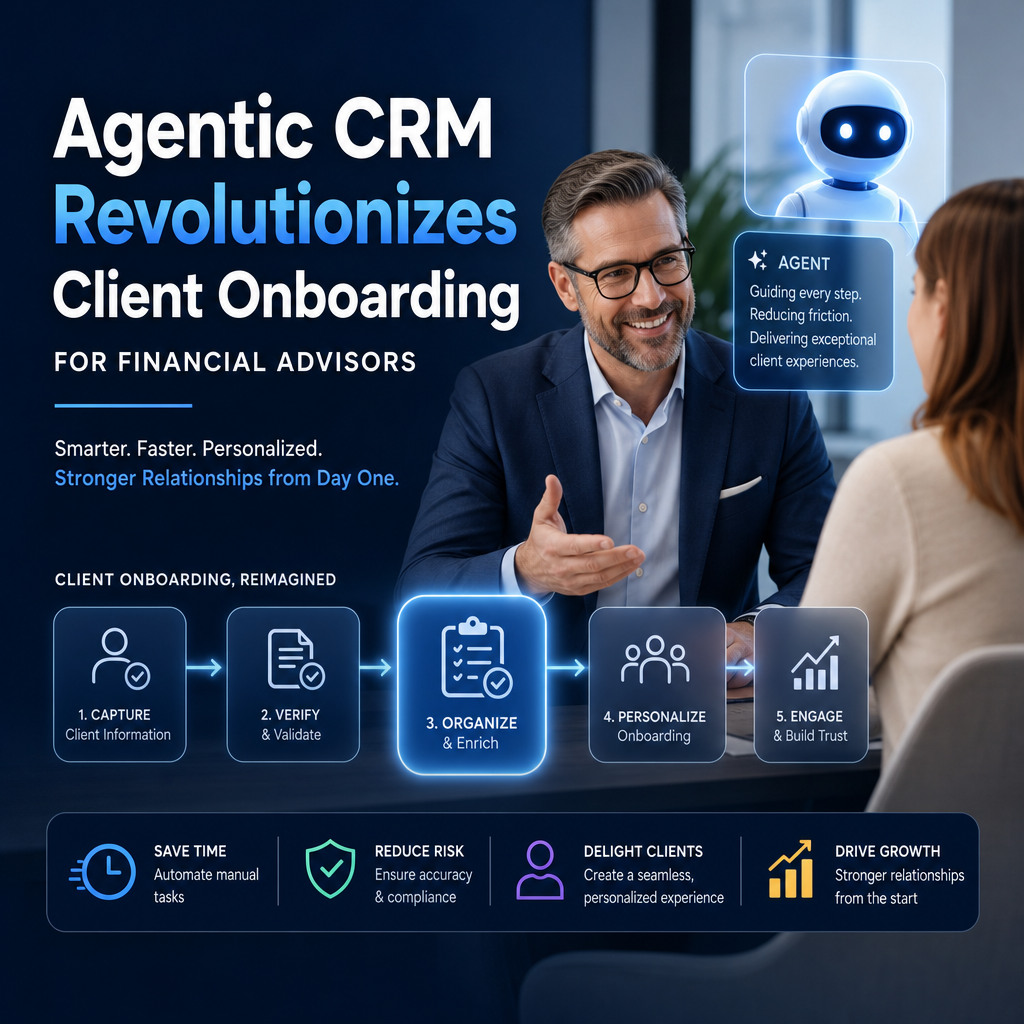
Agentic CRM Revolutionizes Client Onboarding for Financial Advisors
The Agentic CRM Revolutionizing Client Onboarding for Financial Advisors
Client onboarding is one of the most important moments in a financial advisor’s relationship with a new client. It sets the tone for trust, professionalism, and long-term retention. Yet for many advisory firms, onboarding is still slowed down by manual data entry, repetitive follow-ups, scattered documents, and disconnected systems.
That is exactly why the agentic CRM revolutionizing client onboarding for financial advisors is gaining attention. By combining automation with intelligent decision-making, an agentic CRM does more than store client information. It actively helps move onboarding forward, reduce delays, and create a smoother experience from the first meeting to the first portfolio review.
What Is an Agentic CRM?
An agentic CRM is a customer relationship management platform that does more than automate basic tasks. It uses intelligent workflows and AI-driven actions to complete multi-step processes with less human intervention.
For financial advisors, this means the CRM can:
- Track onboarding progress automatically
- Send reminders and next-step prompts
- Collect and organize client documents
- Flag missing information
- Route tasks to the right team member
- Keep the advisor updated in real time
Instead of requiring staff to manually coordinate every step, the CRM acts like a digital operations partner.
Why Traditional Onboarding Slows Firms Down
Onboarding a new client often involves a long list of steps: gathering personal details, confirming goals, collecting account statements, sending forms, checking compliance requirements, and scheduling follow-up meetings. When these steps happen across email threads, spreadsheets, and separate tools, important details can get lost.
Common pain points include:
1. Repetitive data entry
Advisors and staff often re-enter the same client information into multiple platforms.
2. Delayed document collection
Clients may forget to upload forms or provide statements, which can stall the process.
3. Lack of visibility
It becomes difficult to know which clients are fully onboarded and which are still waiting on action.
4. Inconsistent client experience
Some clients receive frequent updates while others are left wondering what happens next.
These issues cost time, create frustration, and can even weaken trust before the relationship fully begins.
How an Agentic CRM Improves Client Onboarding
The biggest advantage of an agentic CRM is that it helps transform onboarding from a manual checklist into a guided, intelligent workflow.
Automated task progression
Once a prospect becomes a client, the CRM can automatically launch the onboarding sequence. It assigns tasks, sends forms, and creates reminders without requiring the advisor to start each step manually.
Smarter communication
The CRM can send timely follow-ups based on client behavior. If a document has not been uploaded, the system can send a reminder. If a meeting is completed, it can trigger the next onboarding step.
Better document management
Instead of relying on email attachments and shared drives, the CRM organizes documents in one place. This reduces confusion and makes it easier to track what has been received.
Compliance support
Financial advisors must maintain accurate records and follow strict procedures. An agentic CRM can help ensure required disclosures, signatures, and approvals are completed before the process moves ahead.
Real-time visibility
Advisors and staff can quickly see where every client stands in the onboarding journey. This makes it easier to prioritize work and prevent bottlenecks.
The Client Experience Also Improves
A smoother internal process leads to a better external experience. New clients want reassurance that they made the right choice. They want clear communication, a sense of progress, and confidence that their advisor is organized.
An agentic CRM supports that by creating a more polished onboarding experience. Clients get:
- Clear instructions on what to do next
- Fewer repeated requests for the same information
- Faster responses and reminders
- A more professional, consistent process
This matters because the onboarding phase is often when clients decide whether they feel comfortable with the relationship. A well-run process can strengthen confidence before any investment strategy is even discussed.
Why Financial Advisors Are Adopting Agentic CRMs
Firms are under pressure to do more with less. Advisors need to spend more time on relationships and planning, and less time on administrative coordination. An agentic CRM helps by reducing manual work and improving workflow efficiency.
It also supports growth. As a firm adds more clients, onboarding can become harder to manage without strong systems. An intelligent CRM makes it possible to scale operations without sacrificing service quality.
Key benefits include:
- Faster onboarding times
- Fewer administrative errors
- Improved team coordination
- Stronger compliance oversight
- A more modern client experience
The Future of Onboarding Is More Intelligent
The rise of the agentic CRM marks a shift in how financial advisory firms think about operations. Onboarding is no longer just a series of manual tasks. It is becoming an orchestrated experience powered by automation, intelligence, and proactive support.
For firms that want to stand out, this is a major opportunity. The advisors who embrace smarter systems will likely deliver faster onboarding, reduce stress on their teams, and create a stronger first impression with every new client.
Final Thoughts
Client onboarding has always mattered, but now it can be a competitive advantage. The agentic CRM revolutionizing client onboarding for financial advisors helps firms simplify processes, improve communication, and deliver a better experience from day one.
In an industry where trust and efficiency go hand in hand, that kind of transformation is hard to ignore.