
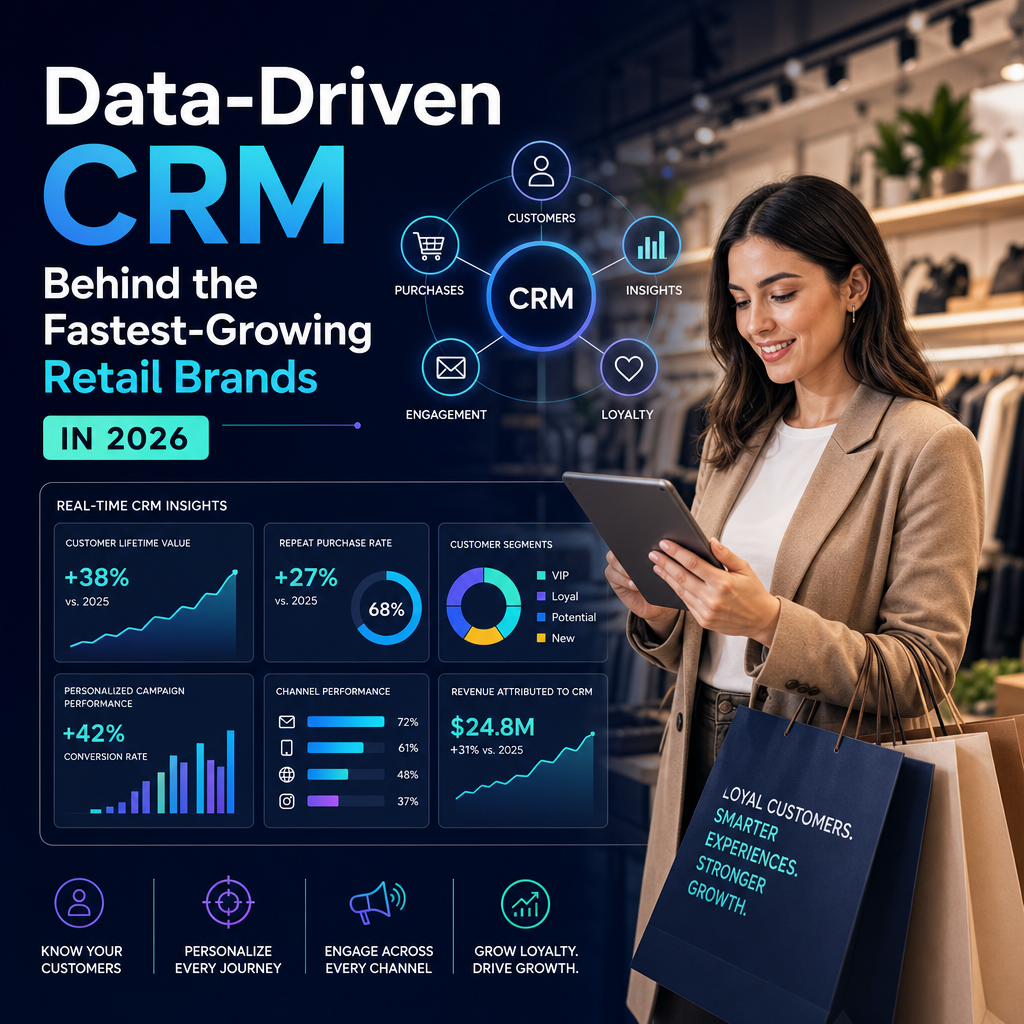
Data-Driven CRM Behind the Fastest-Growing Retail Brands in 2026
The Data-Driven CRM Behind the Fastest-Growing Retail Brands in 2026
Retail growth in 2026 is not being driven by guesswork, broad discounts, or one-size-fits-all campaigns. The brands pulling ahead are using a data-driven CRM to turn customer behavior into real-time action.
That shift matters because modern shoppers expect relevance at every step. They want brands to remember what they browsed, what they bought, how they prefer to shop, and when they are likely to return. Retail brands that can connect those signals are winning loyalty faster than competitors that still rely on static segmentation.
Why CRM looks different in 2026
The old CRM model focused on storing contact details and sending occasional email blasts. Today, the most effective systems do much more.
A data-driven CRM now acts as the operating center for customer engagement. It brings together data from:
- Ecommerce behavior
- In-store purchases
- Loyalty programs
- Mobile apps
- Social interactions
- Customer support conversations
- First-party and zero-party data
When that information is unified, retail brands can respond with precision instead of broad assumptions. The result is better timing, better offers, and better experiences.
The new retail growth engine
Fast-growing retail brands are no longer asking, “How do we reach more people?” They are asking, “How do we understand each person better?”
A strong CRM helps answer that by revealing patterns such as:
1. Purchase intent
Customers often leave clues before buying. They may revisit a product page, save an item, or open a promotion multiple times. A data-driven CRM can detect these signals and trigger the right next step.
2. Lifecycle stage
A first-time buyer needs a different message than a loyal repeat customer. Smart CRM workflows adjust based on where the customer is in the journey, helping brands avoid irrelevant outreach.
3. Channel preference
Some customers respond best to email. Others prefer SMS, app notifications, or social retargeting. The best retail brands use CRM data to meet people where they already are.
4. Churn risk
If a loyal customer suddenly stops engaging, the CRM can flag that drop in activity and launch a recovery campaign before the relationship fades.
What makes a CRM truly data-driven
Not every CRM is built for growth. The ones powering the fastest-growing retail brands in 2026 share a few important traits.
Unified customer profiles
All customer data lives in one place, creating a complete view of each shopper. This makes it easier to personalize campaigns, improve service, and measure long-term value.
Real-time segmentation
Instead of manually sorting customers into static lists, the CRM updates segments automatically. For example, a shopper can move from “browsed but didn’t buy” to “recent purchaser” the moment they convert.
Automation with context
Automation is only useful when it feels relevant. The strongest CRM systems trigger messages based on actual behavior, not just calendar dates.
Predictive insights
Leading brands use the CRM to forecast future actions, such as likely repeat purchase timing, preferred product categories, or the best offer to retain a customer.
How retail brands are using CRM to grow faster
The most successful retail teams are applying their CRM in practical, revenue-focused ways.
Personalized campaigns at scale
Instead of sending the same promotion to everyone, brands tailor offers based on shopping history and interest signals. This improves conversion and reduces wasted spend.
Smarter retention programs
Retention is often more profitable than acquisition. A data-driven CRM helps brands identify at-risk customers and re-engage them before they disappear.
Better product recommendations
When CRM data is connected to buying behavior, product suggestions become more useful. Customers see items that fit their style, budget, and purchase patterns.
Improved customer service
Support teams can use CRM records to understand the full customer journey. That means faster resolutions and more consistent experiences.
More effective loyalty strategies
Retail loyalty works best when rewards feel personal. CRM data helps brands offer incentives that match customer habits instead of generic points-based messaging.
The advantage of first-party data
In 2026, first-party data is one of retail’s most valuable assets. As privacy expectations rise and third-party tracking becomes less reliable, brands need direct customer relationships more than ever.
A data-driven CRM helps collect and activate first-party data through:
- Account signups
- Quiz results
- Preference centers
- Purchase history
- On-site browsing behavior
- Email and SMS engagement
This creates a more stable and compliant foundation for growth. It also gives retail brands more control over how they personalize without depending on outside platforms.
What fast-growing brands do differently
The brands growing fastest in retail do not just collect data. They use it with discipline.
They:
- Keep customer profiles clean and consistent
- Update segments in real time
- Test messages and offers continuously
- Connect CRM insights to merchandising and marketing
- Measure lifetime value, not just short-term sales
This creates a feedback loop where every campaign teaches the brand something new. Over time, that learning compounds into stronger margins and deeper loyalty.
The future of retail growth is customer intelligence
Retail in 2026 rewards brands that can act on customer data quickly and intelligently. A data-driven CRM is no longer a back-office tool. It is the growth system that connects marketing, sales, service, and retention.
The fastest-growing retail brands are using CRM not just to store information, but to shape every customer interaction. That difference is what turns casual shoppers into repeat buyers and repeat buyers into brand advocates.
In a crowded market, the winners will not be the brands with the loudest message. They will be the ones with the clearest understanding of their customers.